WhatsApp Usernames: How to Reserve Yours (2026 Guide)
WhatsApp usernames are rolling out in 2026: how to reserve your @username, the format rules, what changes for privacy, and what businesses must do about it.
 Nicolas ProvostJul 31, 2026 · 5 min read
Summarize this article with an AI
 ChatGPT
 Claude
Table of contents (8)
Key takeaways
- A WhatsApp username is 3 to 35 characters long, uses Latin letters, numbers, periods and underscores, and must be unique.
- The username does not replace the phone number, which still registers the account but no longer has to be shared.
- Usernames are first come, first served, so a brand should reserve its handle in profile settings as soon as its country is covered.
- On the API, a customer who adopts a username appears as a business-scoped user ID (BSUID) instead of a raw phone number.
Quick answer
WhatsApp usernames are here. After years of preparation, Meta is rolling out @usernames on WhatsApp in 2026: pick a unique handle (3 to 35 characters, Latin letters, numbers, periods, underscores) and people can message you without ever seeing your phone number. Reservation opened in the app in the week of June 29, 2026, first come first served. The phone number does not disappear: it is still how the account is registered, it just stops being the thing you have to hand out.
What Was Actually Announced
The timeline, in facts:
- October 2024: Meta first disclosed it was working on username support for WhatsApp.
- June 29, 2026: WhatsApp announced that username reservation was opening that week, under Settings, then Account, then Username. The same day, businesses could start reserving and claiming their username, according to Meta's developer documentation.
- The following months: WhatsApp says usernames roll out gradually, with an in-app notification when they are available in your country. It has not published a date per country, and Meta's documentation notes that the changes it describes are subject to change (pages read on October 8, 2026).
The format rules are simple: 3 to 35 characters, using Latin letters, numbers, periods and underscores. One username per account, unique across WhatsApp.
Why This Is a Big Deal for Privacy
Until now, messaging someone on WhatsApp meant exchanging phone numbers, the most personal identifier most people carry. Usernames break that link: a classmate, a marketplace buyer, or a customer can start a chat with @yourhandle while your number stays private. For the conversations themselves, WhatsApp chat lock is the built-in way to keep a chat out of sight.
Registration still requires a phone number behind the scenes, so this is not anonymity. It is contact without disclosure, the same model that made handles the default on every other social network.
Reserve Your Brand Name Now
For a business, the practical urgency is simple: usernames are unique and first come, first served. The scramble looks exactly like every handle land-grab before it. If your brand name is available, reserve it before someone else does:
- Update WhatsApp to the latest version.
- Open Settings, then Account, then Username.
- Pick your handle, ideally matching your Instagram and TikTok handles.
- Confirm, and the reservation is held for your account.
If the rollout has not reached your country yet, check back after each update: WhatsApp notifies you in the app when usernames are available in your country.
What Changes for Businesses on the API
This is the technical part, and it matters if WhatsApp is a sales channel for you.
When a customer adopts a username, businesses on the WhatsApp Business API stop seeing that customer's raw phone number. Instead they receive a business-scoped user ID (BSUID): a unique identifier delivered in the webhook user_id field. Two properties define it:
- Unique per user: no two users share a BSUID.
- Scoped to the business: the same customer has a different BSUID with every business portfolio, so identifiers cannot be cross-referenced between companies.
The transition has been staged since early 2026: BSUIDs began appearing in webhooks in early April 2026, according to Meta's documentation, and WhatsApp's contact book maps existing phone-number relationships automatically. That auto-mapping is why existing customer relationships are protected: your opt-in list does not evaporate when customers adopt usernames.
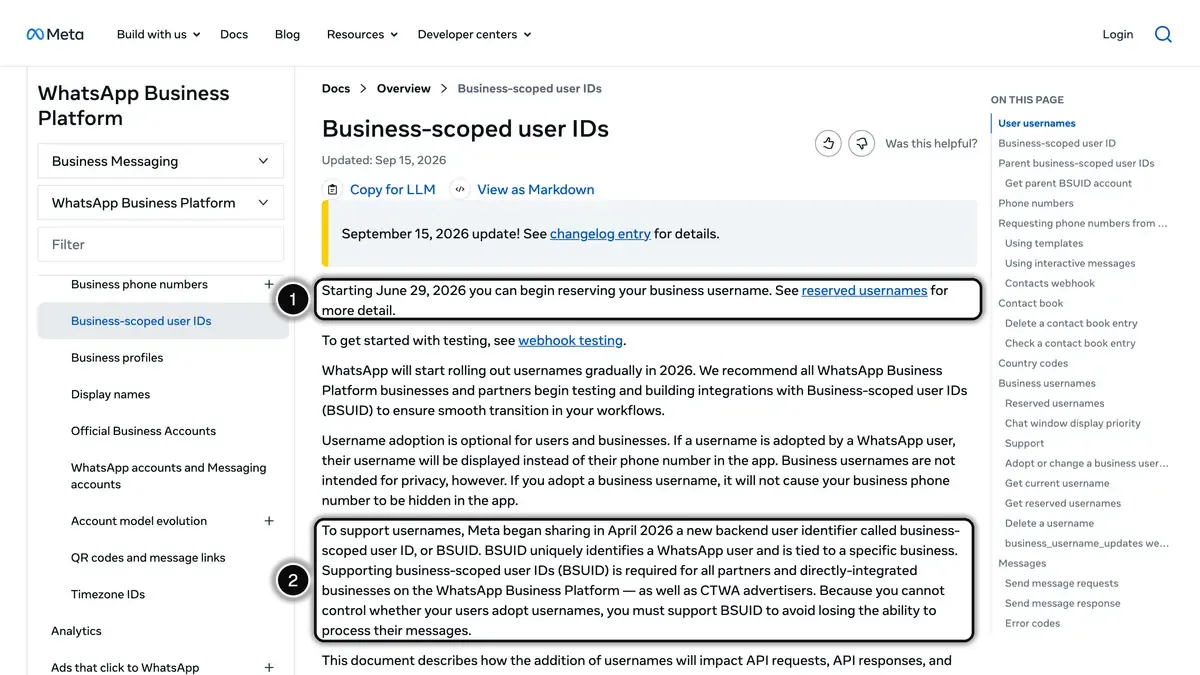 In 1, when businesses can start reserving a username; in 2, the BSUID that Meta began sharing in April 2026.
What breaks without preparation: click-to-WhatsApp ad conversations and inbound messages from username-adopting users, on systems that never learned to read BSUIDs. Platforms handling this properly needed to update their webhook parsing, store the new identifier alongside profiles, and use the Request Contact Info flow for the rare cases where an actual phone number is required.
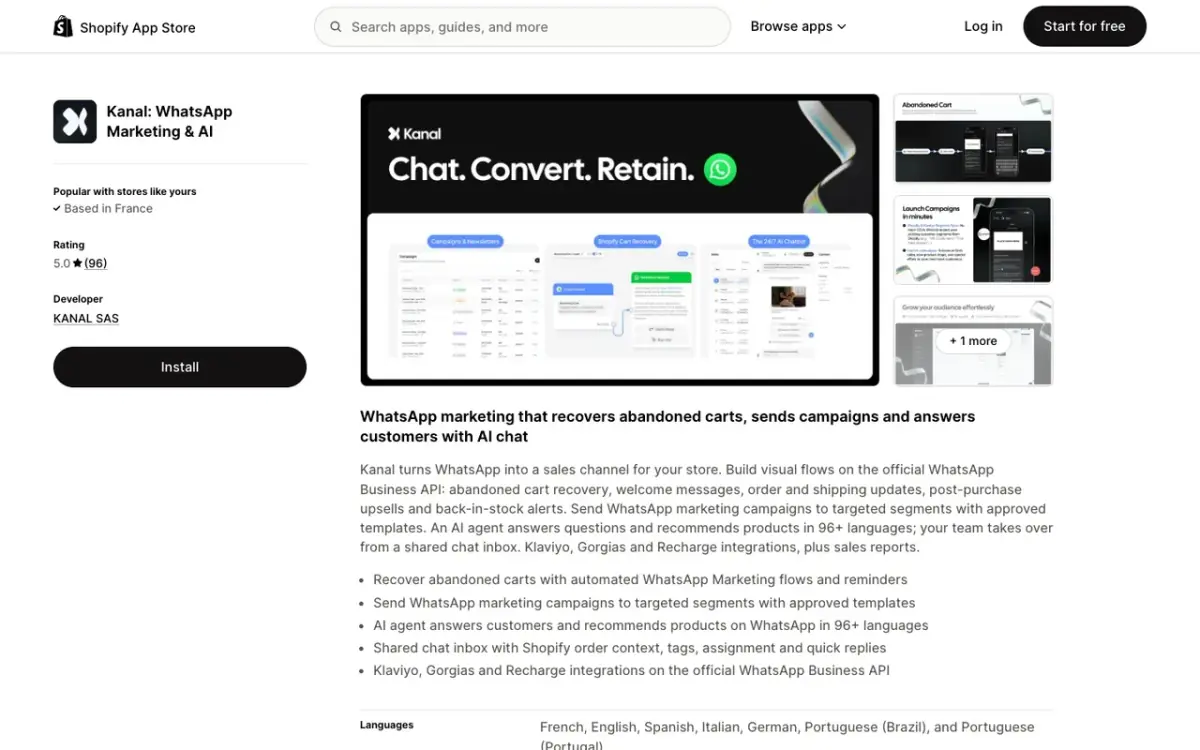
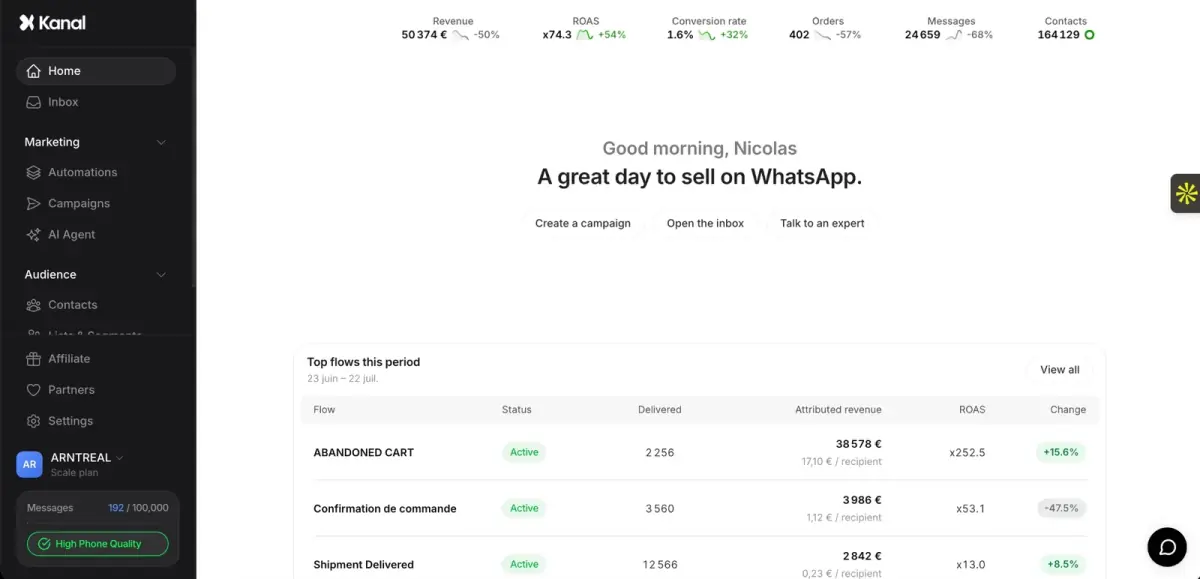
If you run your WhatsApp marketing through Kanal, this plumbing is the platform's job, not yours. Campaigns, abandoned cart recovery and the AI agent keep working whether a customer shows up as a phone number or a BSUID.
What This Changes for WhatsApp Marketing
Three practical consequences worth planning for:
- A brandable identity. @yourbrand on WhatsApp becomes an asset like your Instagram handle: printable on packaging, clickable in bios, consistent across channels.
- Lower friction to opt in. Customers reluctant to hand a store their phone number can start the relationship through a username instead. Expect opt-in flows to lean on this.
- Identifier hygiene becomes invisible infrastructure. The platforms that adapted early will simply keep working; merchants gluing their own integrations together have webhook work to do.
Conclusion: Claim the Handle, Let the Plumbing Be Someone Else's Job
Usernames are the biggest identity change WhatsApp has shipped since the app launched: contact without phone numbers, handles as brand assets, and a quiet re-architecture of how businesses identify customers underneath. The to-do list for a merchant is short: reserve @yourbrand as soon as your country wave lands, keep your opt-in quality high, and run the channel on a platform that has already done the BSUID work. If that last part sounds like something you would rather not build yourself, book a Kanal demo.
Resources
See Kanal on your own store
- Your campaigns and cart reminders on WhatsApp, starting from your own store
- Post-purchase offers, back-in-stock alerts, then the AI agent that advises your customers
- You leave with the plan that fits and its price
From €89/month
- brands
- 500+
- to set up
- 5 min
- open rate on WhatsApp
- +90%
Nicolas helps e-commerce brands grow revenue with WhatsApp marketing. With deep expertise in Shopify ecosystems and conversational commerce, he shares proven strategies for abandoned cart recovery, broadcast campaigns, and AI-powered customer engagement.