RCS pricing: RCS message cost in the US and how carriers bill it
RCS pricing for US brands: how carriers bill Rich and Rich Media messages, public per-message rates and carrier fees in USD, RCS vs SMS cost, billing outside the US, and how to estimate a campaign.
 Nicolas ProvostOct 19, 2026 · 6 min read

Summarize this article with an AI
 ChatGPT
 Claude
Table of contents (7)
Key takeaways
- There is no single RCS price: US carriers set the rates, and Google only defines which messages are billable and how they are counted.
- In the US, a text-and-buttons Rich Message is billed per 160-byte segment, and anything with a card, media or advanced action is a flat-rate Rich Media Message.
- Twilio's public US rates match its SMS and MMS rates: $0.0083 per RCS Rich segment and $0.022 per Rich Media message, before carrier fees.
- Outside the US, Google's standard model separates basic and single messages, and conversational agents can be billed per 24-hour conversation.
RCS pricing has no single public number: carriers set the rates and Google defines what counts as a billable message. What a US brand pays depends on four things: the carrier of each recipient, the type of message (text with buttons, or rich media), the carrier fees on top, and the provider's own margin. This guide explains how US carriers bill RCS, shows public rates in USD, compares RCS with SMS, covers billing outside the US and gives a method to estimate a campaign.
All figures come from Google's RCS for Business documentation and Twilio's public pricing pages, read on October 19, 2026. Prices change: check them before you budget.
Who sets the price of an RCS message?
Google's billing overview (last updated June 3, 2026) splits the roles:
- Carriers set the rates. RCS for Business traffic is billable "according to the carrier's rate card", and each carrier's rate card determines whether a billable event results in a charge.
- Google defines the events, under two models: the US model for US phone numbers and the Standard model for the rest of the world.
- Your provider sells you the service. Brands reach RCS through a messaging partner (an aggregator, a CPaaS provider or a carrier) that charges its own price per message, with or without carrier fees included.
RCS message cost in the US: Rich vs Rich Media
For US numbers, Google's US billing model (last updated July 21, 2026) classifies each message by its format, and US carriers set the price:
| Type | What it contains | How it is counted |
|---|---|---|
| Rich Message | Text, suggested replies, and only two kinds of suggested actions: dial a number, open a URL in the browser | Per segment of 160 bytes of UTF-8 text, rounded up; text in buttons is not counted |
| Rich Media Message | At least one rich card or carousel, a media file, or another suggested action (view or share a location, calendar event, URL in a webview) | One flat-rate event |
Google notes that emojis and accented letters take several bytes, so a 160-character message can be longer than one segment. A cart reminder with a product card is a Rich Media Message; a short text with a link and a reply button is a Rich Message.
Public US RCS rates and carrier fees
Few providers publish RCS prices. Twilio does. These are list prices in US dollars, before volume discounts; Twilio states that prices may change without notice and that carrier fees apply on top.
| Message | Twilio list price (outbound) | Same page, for comparison |
|---|---|---|
| RCS Rich | $0.0083 per segment | Long code SMS: $0.0083 per segment |
| RCS Rich Media | $0.022 per message | Outbound MMS: $0.022 |
US carrier fees per outbound message listed on the same page:
| Carrier | RCS Rich | RCS Rich Media |
|---|---|---|
| AT&T | $0.0045 | $0.01 |
| T-Mobile | $0.0062 | $0.0125 |
| Verizon | $0.005 | $0.007 |
| US Cellular | $0.0062 | $0.0135 |
| All other carriers | $0.0045 | $0.01 |
Source: Twilio SMS and RCS pricing, United States, read on October 19, 2026. Twilio also lists carrier onboarding fees for RCS senders launching on US carriers, and a $0.001 fee on messages that end in a failed status.
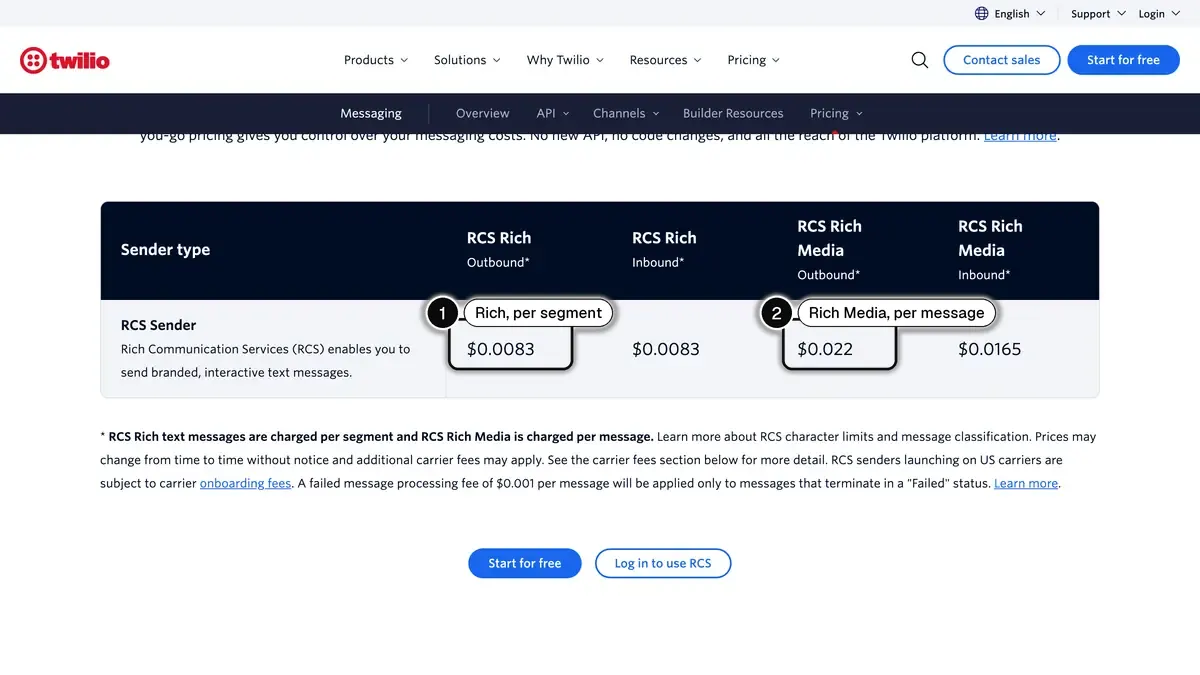 In 1, $0.0083 per outbound RCS Rich segment; in 2, $0.022 per outbound Rich Media message.
Other providers price differently; these tables show what a public US rate card looks like, not what you will pay.
RCS vs SMS cost
On Twilio's US rate card, text costs the same on both channels ($0.0083 per segment), and rich media costs the same as MMS ($0.022). The cost difference for a US brand therefore sits mostly in the carrier fees and in reach: SMS reaches any mobile number, RCS only phones and carriers that support it, so a campaign needs a fallback for the rest. Our comparison of WhatsApp vs SMS pricing by country covers SMS rates in 20 markets, and our WhatsApp Business pricing guide explains Meta's per-message model.
How to estimate the cost of an RCS campaign
- Count reachable recipients. Not every phone can receive RCS: on iPhone it needs iOS 18 and a supporting carrier.
- Classify the message. Text and buttons only: Rich (per segment). With a card, a carousel or an image: Rich Media (flat).
- Get your provider's rate for that type, plus the carrier fee for each carrier in your list.
- Multiply the number of delivered messages by rate plus carrier fee, then add the cost of the SMS fallback for recipients RCS did not reach.
- Compare with the revenue the campaign brings. Our ROAS break-even calculator helps set the threshold.
RCS business messaging pricing outside the US
Under Google's standard model, every agent has a billing category, chosen when the agent is created and not changeable afterwards (standard billing FAQ, last updated August 25, 2026):
| Billing category | Meant for | How it is billed |
|---|---|---|
| Non-conversational | Mostly one-way messages: alerts, one-time passwords, promotional offers | Per message delivered |
| Conversational | Back-and-forth exchanges | Per conversation when one party replies within 24 hours; per message otherwise |
Within those categories, Google counts a basic message (text only, 160 characters or less), a single message (rich content, or text over 160 characters), business-initiated and user-initiated conversations, and user messages.
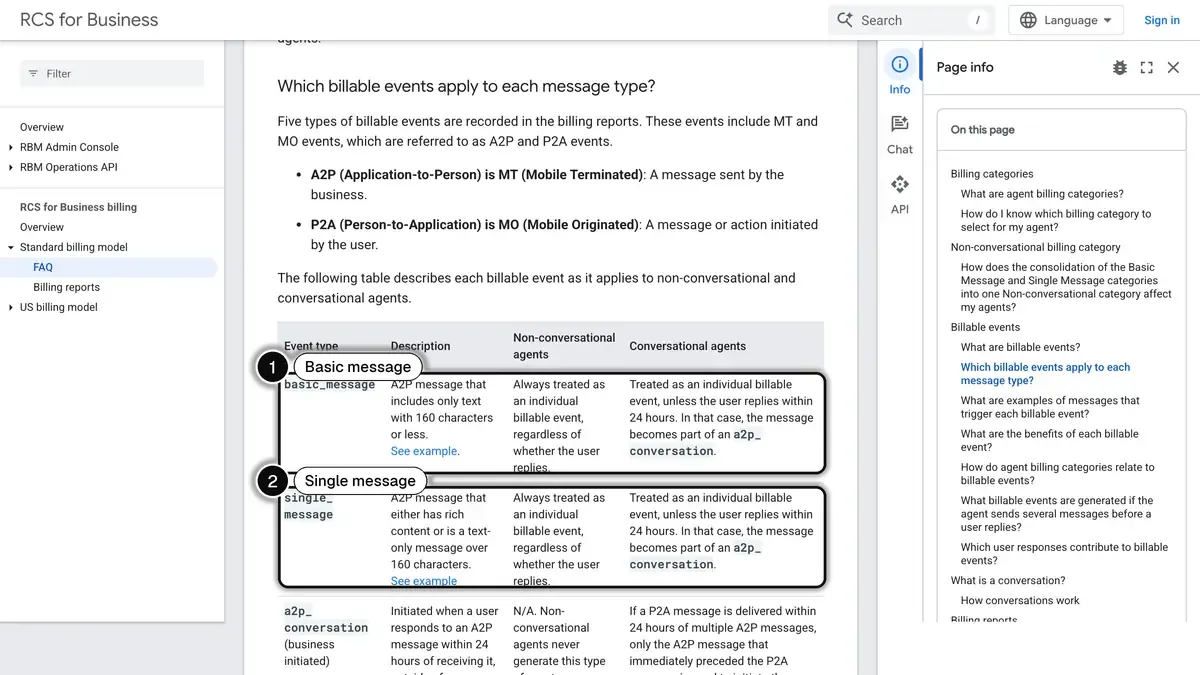 In 1, a basic message: text only, 160 characters or less; in 2, a single message: rich content or longer text.
Details that change a budget: a tap on a suggested action does not count, while a tap on a suggested reply counts as a user message; the automatic STOP sent when a user taps Unsubscribe counts as a user message; and billing follows delivery, with retries for up to 30 days. As a public example, Twilio's France page lists $0.0798 per basic RCS message and $0.1835 per single RCS message.
For what each format can show, read RCS messaging examples and our RCS business messaging guide.
RCS pricing with Kanal
Kanal brings RCS to Shopify stores alongside WhatsApp and SMS: product carousels, cart reminders with a "Resume my cart" button, order tracking and back-in-stock alerts, with the orders and revenue of each send attributed to it. RCS pricing is given during the demo, based on your store and the countries you send to.
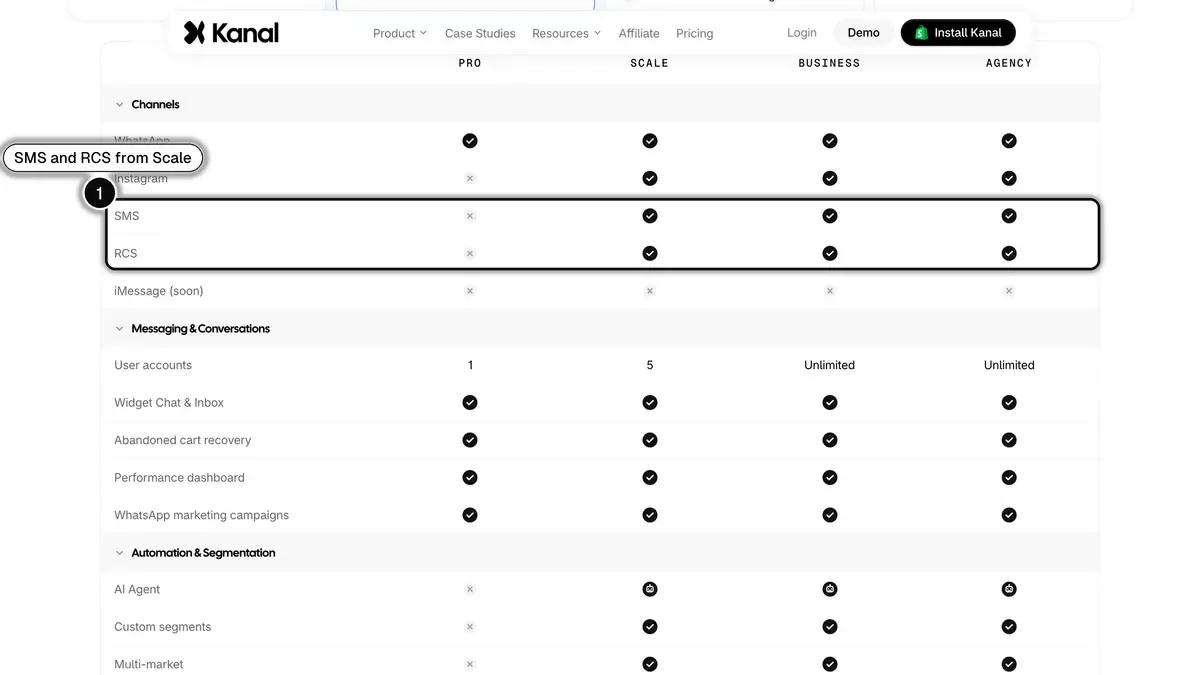
On Kanal's pricing page, RCS and SMS are part of the Scale plan (149 EUR per month) and above. Kanal installs on your Shopify store in about five minutes and more than 500 brands use it. See RCS marketing for Shopify or book a demo to get an estimate for your volumes.
See RCS on your own store
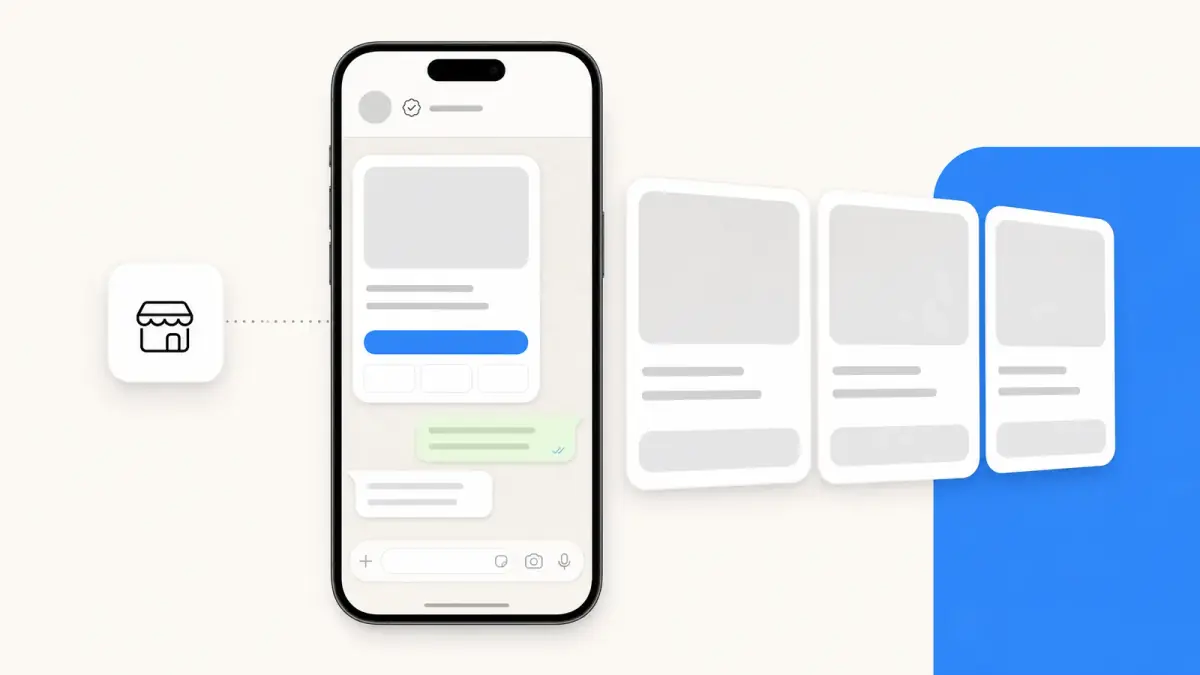
- One card per product: image, title, price and a button
- Your brand name and logo, with a verification check mark
- Sent from Kanal, alongside your WhatsApp campaigns
Available from the Scale plan
See Kanal's RCS marketingToday 10:02
The linen collection is back, Sarah.
See the collection
- brands
- 500+
- to set up
- 5 min
- open rate on WhatsApp
- +90%
Nicolas helps e-commerce brands grow revenue with WhatsApp marketing. With deep expertise in Shopify ecosystems and conversational commerce, he shares proven strategies for abandoned cart recovery, broadcast campaigns, and AI-powered customer engagement.