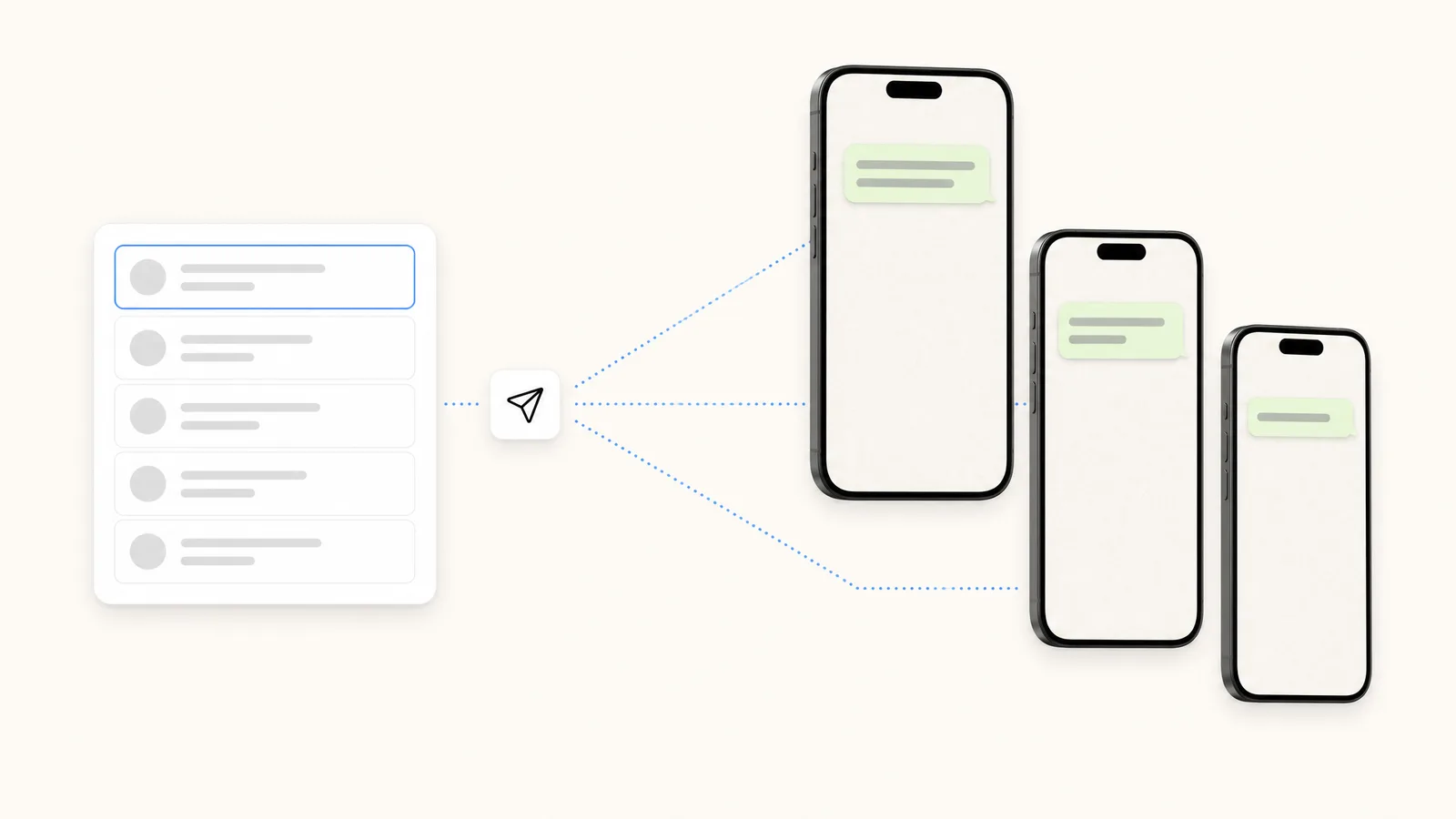
10DLC registration: the SMS guide for US online stores
10DLC registration explained for US online stores: what A2P 10DLC is, who must register, brand and campaign steps with The Campaign Registry, fees and timelines from Twilio and AWS, and what changes on Shopify.
 Nicolas ProvostOct 19, 2026 · 13 min read

Summarize this article with an AI
 ChatGPT
 Claude
Table of contents (15)
Key takeaways
- A2P 10DLC is the system US carriers use so that business texts sent from 10-digit long code numbers are verified and consensual.
- A store cannot register directly with The Campaign Registry: its SMS provider registers the brand and the campaign on its behalf.
- Twilio passes through a $4.50 brand fee ($46 for a Standard brand with vetting), a $15 campaign vetting fee and a monthly campaign fee, read October 19, 2026.
- AWS lists up to 4 weeks for campaign approval, so register before the season you want to text in, with your opt-in flow and sample messages ready.
10DLC registration is the step every US business goes through before texting customers from a regular 10-digit phone number: it tells carriers who is sending (the brand) and what will be sent (the campaign). For an online store, it is not a form you fill in on your own. The Campaign Registry only accepts registrations from messaging providers, so your SMS app or provider registers your store, and you supply the details it needs.
This guide is written for US merchants, Shopify stores first. It explains what A2P 10DLC is, who must register, the brand and campaign steps, what the fees and timelines look like, why campaigns get rejected, and what to prepare on your store. The facts come from The Campaign Registry, Twilio's documentation and help center, and the AWS End User Messaging guide, all read on October 19, 2026. Twilio and AWS are used as references because they publish their process and fees in detail; your provider's figures may differ.
What is 10DLC?
10DLC stands for 10-digit long code: a regular local US phone number, as opposed to a toll-free number or a short code. A2P means application to person: messages a person receives from a business system rather than from another person. Twilio's A2P 10DLC documentation puts the two together: A2P 10DLC is "the standard that United States telecom carriers have put in place to ensure that SMS traffic to US end users through long code phone numbers is verified and consensual".
Why it exists, in Twilio's words: long code numbers were designed for person-to-person texting, those routes were unregulated, and spam pushed many consumers to lose trust in SMS. Registration makes sure people can opt in and out and know who is texting them. For the sender, Twilio lists higher throughput, brand awareness and accountability.
The registry behind it is The Campaign Registry (TCR). Its homepage describes 10DLC as "an A2P messaging channel in which Brands and Campaign Service Providers (CSPs) are verified prior to being allowed to send messages", with brands, providers and message content all known upfront.
Who must register for A2P 10DLC?
Twilio's rule is short: anyone sending SMS or MMS over a 10DLC number from an application to the US must register. Carriers treat every message sent through a messaging provider as application to person, so a store texting its customers from a marketing tool is in scope, whatever its size.
Three points matter for a store:
- You do not register with TCR yourself. TCR states that "direct registration with TCR is not available for Brands": a company that wants to text its customers works with a registered messaging service provider, the CSP, "who will handle your registration process on your behalf".
- Toll-free numbers and short codes are outside 10DLC. Twilio says they are not part of the A2P 10DLC system and can also be used to text people in the US. They have their own processes (toll-free verification, short code applications).
- Skipping it costs more and delivers less. Twilio says unregistered 10DLC traffic pays additional carrier fees, and that registration brings lower message filtering and higher throughput.
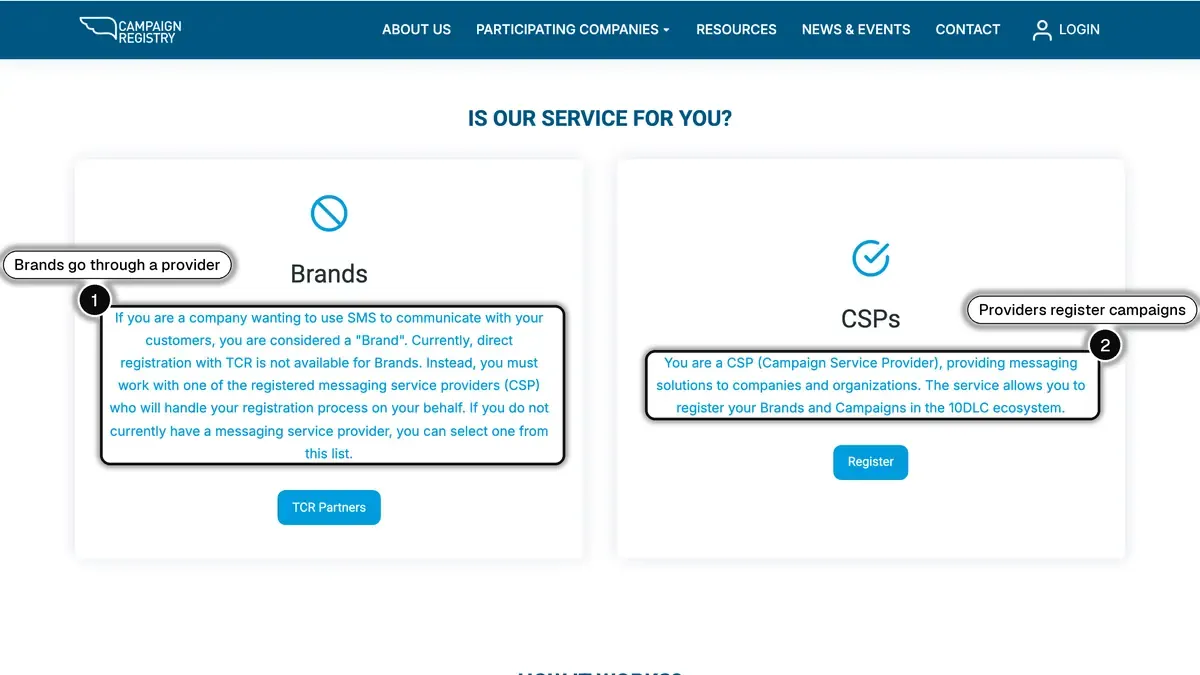 In 1, TCR sends brands to a registered messaging provider; in 2, the provider is the one that registers brands and campaigns in the 10DLC ecosystem.
10DLC vs toll-free vs short code
A US store can text from three kinds of numbers. Twilio's US SMS pricing page describes them this way, and the AWS guide adds when it recommends a short code.
| Number type | What it is | Registration | Notes from the sources |
|---|---|---|---|
| 10DLC (long code) | A 10-digit local number | A2P 10DLC: brand and campaign through your provider | AWS: one number per campaign, numbers can be added to a campaign |
| Toll-free | A number with a 3-digit prefix such as 887, for high-throughput SMS | Toll-free verification, outside 10DLC | Twilio lists the same outbound SMS price as long codes |
| Short code | A 5 or 6 digit number for high-throughput two-way SMS | Short code registration, outside 10DLC | AWS recommends it when you need high throughput and deliverability across all US carriers |
On 10DLC, throughput is set by the carriers, not by your provider. The AWS 10DLC guide explains that AT&T gives each campaign a per-second send rate, T-Mobile sets a daily message cap per campaign, and Verizon relies on spam filtering rather than published throughput limits. AWS adds that no SMS sending service can raise 10DLC throughput beyond these rates.
A2P 10DLC registration steps
Twilio splits registration into two parts: the brand (who is sending, so carriers know you are a legitimate sender) and the campaign (how people opt in and out, how they get help, and what the messages are for). AWS adds a vetting step between the two. Here is the path for a store, with the details each step asks for.
1. Gather the business details
For a Standard or Low Volume Standard brand, Twilio asks for a tax ID: an EIN for a US company. Its direct registration guide insists on accuracy: the information should match how you registered with the tax agency, because it feeds the Trust Score that TCR assigns, which sets your throughput and daily limits. Prepare:
- the legal business name, EIN and address, exactly as on your tax records;
- your store's website, with a privacy policy and terms that describe your SMS program;
- a business contact email you can access: since October 17, 2024, public for-profit brands verify their identity through this email (Twilio's guide).
2. Register the brand
Your provider submits the brand to TCR. Twilio says the TCR review typically happens within minutes, but a manual third-party review takes seven business days or more. Twilio offers three brand types:
| Brand type | Who it fits | Daily volume to T-Mobile, per Twilio |
|---|---|---|
| Sole Proprietor | Individuals without an EIN | 1,000 SMS segments and MMS |
| Low Volume Standard | Businesses with a tax ID sending fewer than 6,000 segments a day | Up to 2,000 SMS segments and MMS |
| Standard | Businesses with a tax ID and more volume | From 2,000 to unlimited, depending on the Trust Score |
A Standard or Low Volume Standard brand can register up to five campaigns, and one tax ID can register up to five such brands, according to Twilio.
3. Vet the brand
Vetting is a check by a third-party provider that produces a score. AWS explains that a higher score can raise the throughput tier your campaigns qualify for, and that the score is not applied retroactively to campaigns created before it. Vet the brand first, then create the campaigns.
4. Register the campaign
The campaign describes one messaging program. The fields come from Twilio's campaign troubleshooting guide:
- Use case. Twilio's list of use cases includes Marketing (promotional content such as sales and limited time offers), Delivery Notifications, Account Notifications, Customer Care and Mixed, which covers several use cases and is likely to have lower throughput and a higher cost per message.
- Description of what the messages are for.
- Message flow: every way a customer can opt in, for example a checkbox at checkout and a keyword, with links to your terms and privacy policy.
- Two to five sample messages, between 20 and 1,024 characters each, that reflect the real messages and show templated fields in brackets. At least one sample must include your business name.
- Links and phone numbers: declare whether messages will contain them, and show them in the samples.
- Opt-in confirmation message if customers can join by texting a keyword: it should name the brand and confirm enrollment in a recurring program.
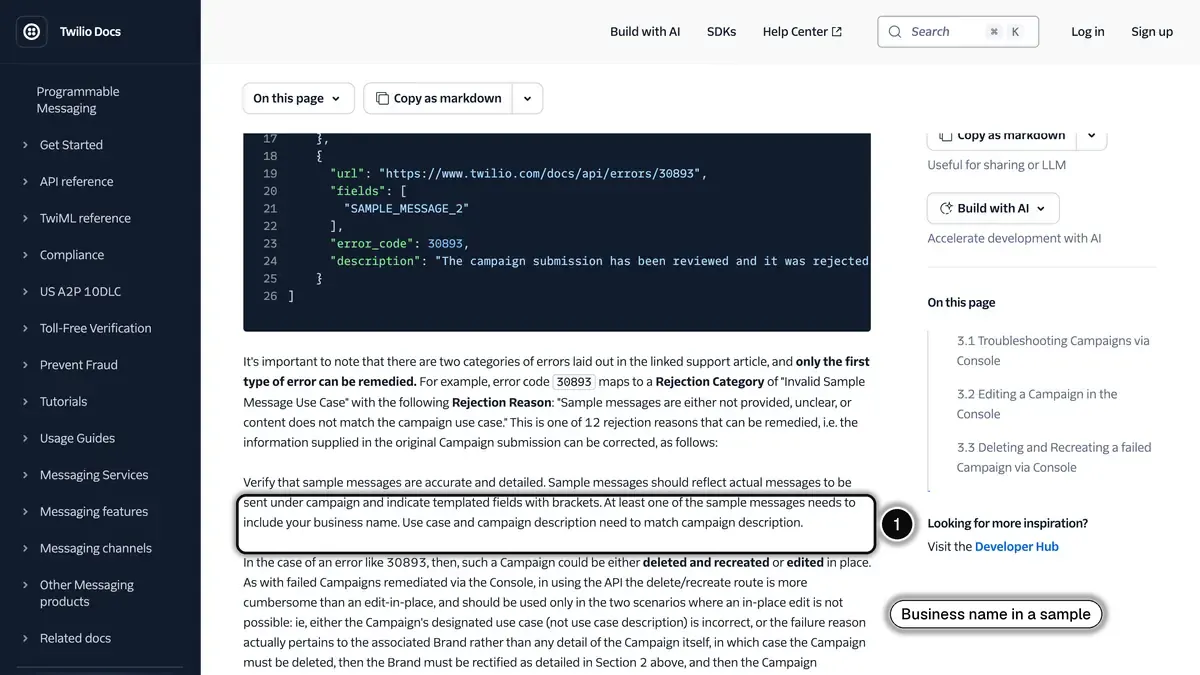 In 1, the rejection reason for unclear sample messages and how to fix it: real messages, fields in brackets, the business name in at least one sample.
5. Attach the number and start sending
Once the brand and campaign are approved, the 10DLC number is linked to the campaign. AWS notes that a number cannot be shared across several campaigns, so each campaign needs at least one number of its own.
How long does 10DLC registration take?
| Step | US based companies | International companies |
|---|---|---|
| Register your brand | 1 to 2 business days | Up to 3 weeks |
| Apply for vetting | 1 to 2 business days | Up to 3 weeks |
| Register your campaign | Up to 4 weeks | Up to 4 weeks |
| Request your 10DLC number | Up to 10 days | Up to 10 days |
Source: AWS End User Messaging SMS user guide, read on October 19, 2026.
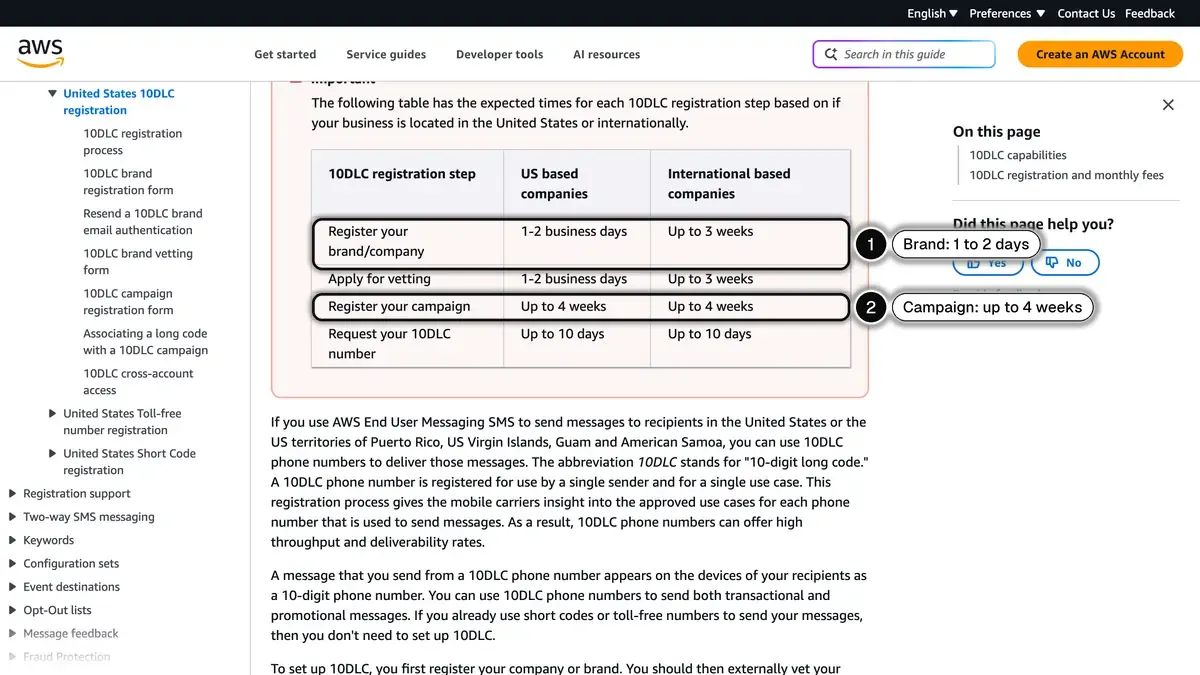 In 1, brand registration takes 1 to 2 business days for a US company; in 2, campaign registration can take up to 4 weeks.
Twilio gives its own estimates: 72 hours or more to approve the customer profile, and a manual campaign vetting that "can take between two to three weeks". When we read the guide, a banner said campaign reviews were taking 10 to 15 days because of an increase in submissions. For a store, the practical rule is simple: register well before the sale you plan to text about.
How much does 10DLC registration cost?
There are two kinds of fees, per Twilio's fee page: registration fees, charged when the brand and the campaign are registered with TCR, and carrier fees, charged per message. Twilio says both are charged by carriers as part of the system and passed through with no added cost.
| Fee | Amount on Twilio, read October 19, 2026 |
|---|---|
| Brand registration, Sole Proprietor or Low Volume Standard | $4.50 one time |
| Brand registration, Standard (includes secondary vetting) | $46 one time |
| Campaign vetting | $15 per campaign |
| Monthly campaign fee, standard use case | $10 per month |
| Monthly campaign fee, low-volume mixed use case | $1.50 per month |
| Monthly campaign fee, Sole Proprietor | $2 per month |
| Authentication Plus, public for-profit brands | $12.50 per retry |
The page also notes that TCR raised some fees on August 1, 2025 (brand registration from $4.00 to $4.50, standard vetting from $40.00 to $41.50).
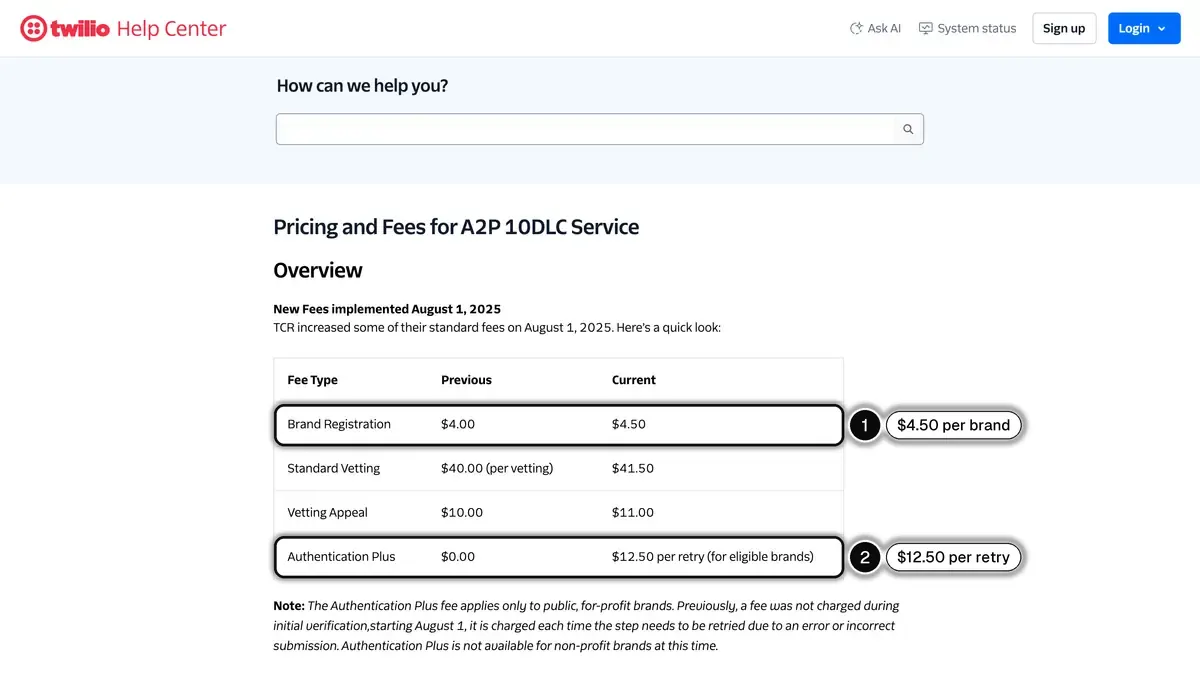 In 1, the brand registration fee went from $4.00 to $4.50 on August 1, 2025; in 2, Authentication Plus is charged $12.50 each time the step has to be retried.
Carrier fees come on top of your provider's price, per SMS segment. On Twilio's US pricing page, read the same day, the outbound SMS carrier fee on a long code was $0.0035 on AT&T, $0.0045 on T-Mobile and $0.005 on Verizon and US Cellular. Our SMS marketing pricing guide puts these fees next to the per-message rates of SMS platforms.
Why 10DLC campaigns get rejected
Twilio's troubleshooting guide lists the failures it sees most. Most can be fixed by editing the submission; some cannot.
Fixable by editing:
- Unclear sample messages, or samples that do not match the use case. Rewrite them from real messages, with your store name.
- A vague campaign description. Say what you send, to whom and how often.
- Public link shorteners. TCR only accepts shortened links on a dedicated, branded short domain that belongs to your business; a link from bit.ly or TinyURL in a sample leads to rejection.
- A mismatch between the use case and the messages. If the wrong use case was picked, Twilio says the campaign has to be deleted and created again.
Not fixable by editing: content violations. Twilio's list covers content about sex, hate, alcohol, firearms, tobacco or marijuana, and use cases judged high risk for spam, phishing or fraud. The remedy is an appeal or a change of campaign. Campaigns can also be suspended after approval, for example when live traffic does not match the registered campaign, for spam, for sharing opt-ins with affiliates, or for a missing age gate on a campaign that needs one.
If your store sells age-restricted products, ask your provider how it registers that kind of campaign before you build the program.
What changes for a Shopify store
10DLC sits between your store and your customers' phones, but most of what reviewers check lives on your store:
- Your opt-in has to match your campaign. The message flow you declare is the one shoppers see: the SMS consent checkbox at checkout, a signup form, a keyword. Shopify lets you collect SMS marketing consent at checkout; our SMS opt-in guide covers what US rules expect from the wording and the records.
- Your website is part of the file. Publish the privacy policy and terms that describe the SMS program before registering, since the campaign links to them.
- Your samples should look like your flows. If you plan a cart reminder, a shipping update and a weekly campaign, show one of each, with your store name and your own domain. Our abandoned cart text guide and SMS marketing examples give wording to start from.
- Pick the use case that matches the program. A store that sends promotions and order updates from the same number falls under a mixed or marketing use case; check with your provider which one fits.
- Plan the calendar. With up to four weeks for campaign approval at AWS, a store that wants to text for a holiday sale should register weeks before.
Where Kanal fits
Kanal sends SMS campaigns and automated texts from your Shopify data: campaigns to your segments, abandoned cart reminders, order and delivery updates, with the orders each send brings in. See Kanal's SMS marketing platform, SMS campaigns and SMS automation.
Texting is not the only way to reach a phone. RCS for Shopify stores adds product cards and buttons in the phone's messaging app and has its own brand verification, iMessage with Kanal, coming soon, will let your store write first in Apple's Messages app, and WhatsApp marketing goes through Meta's platform rather than carrier numbers.
The short version
- A2P 10DLC is how US carriers verify businesses that text from 10-digit numbers: one brand, then one campaign per program.
- A store cannot register alone: its SMS provider registers it with The Campaign Registry.
- Fees are small next to message costs (on Twilio: $4.50 or $46 per brand, $15 per campaign vetting, $1.50 to $10 per month per campaign), but approval can take weeks.
- Most rejections come from the file: vague samples, public link shorteners, an opt-in flow that does not match the store. Prepare them before you submit.
This page is general information, not legal advice.
See Kanal's SMS on your own store
- Bulk SMS campaigns to your customer segments
- Automated texts on every store event, cart reminders included
- The revenue of each send, next to your WhatsApp campaigns
Available from the Scale plan
See Kanal's SMS marketingAutomated SMSYesterday, 6:40 PM
Atelier Nova: your cart is waiting, Sarah. Finish your order here: atelier-nova.com/cartReply STOP to opt out.
- brands
- 500+
- to set up
- 5 min
- open rate on WhatsApp
- +90%
Nicolas helps e-commerce brands grow revenue with WhatsApp marketing. With deep expertise in Shopify ecosystems and conversational commerce, he shares proven strategies for abandoned cart recovery, broadcast campaigns, and AI-powered customer engagement.